
About Lionshare

Every Monday, before the market opens, I publish a full stock portfolio I run with my own money. Every position with its exact weight and stop level, and the reasoning behind that week’s picks.
The complete record is public on Dub, live since January 15, 2026 and impossible for me to edit, so you can check it before you trust it. It has more than doubled while the broad market moved in single digits, and the winning weeks and the losing ones sit next to each other, exactly as they happened.
Live track record on Dub · The Backtest
The money in it is mine, on the way from $30K toward $1M, so every number you check came from real capital in a real brokerage. The deepest drawdown behind those returns, across six years of testing, was about a third of the portfolio.
Why this is different
When you go looking online for a better way to invest, the same three problems keep coming up.
You cannot check the people making the recommendations. Screenshots get cropped, track records show only the good months, the losses disappear.
Doing it properly yourself turns into a second job you do not have time for.
The safe option, an index fund, crawls while your money waits.
This is built deliberately against all three.
The full record is public and uneditable, so you verify it before you follow, not after.
The work is thirty minutes on Monday, then the week is free.
It is built for high growth, with the proof sitting in the open.
What you get
The free tier gets the recap every week. The actual numbers, up or down, written the same way either way. That part is public and always will be.
The paid tier, $39/month or $350/year, gets the full Monday portfolio. Every position, weight, stop, and the reasoning, before the market opens. The weekly recap comes with it.
Both get the same transparency and the same story as it unfolds week by week. Cancellation works anytime. Two posts a week, nothing else.
Who this is for
Someone who already invests and wants a repeatable process instead of gut calls and hot tips. Someone who wants to beat the market over years without making investing a second job, and who would rather trust a process tested hard and running live in the open than a voice promising returns it won’t show.
Your account size is not the constraint. Whether you bring a few thousand or a few hundred thousand, you get the same portfolio, in your own account.
It is not for everyone. The portfolio is concentrated and it draws down. If watching roughly a third of the account go red in a bad stretch would end the experiment for you, this is not your system.
If you would rather verify the results yourself before you follow, they are public on Dub and have been since day one.
The strategy and the backtest
I wanted three things from a strategy.
It had to beat the market over multi-year periods, not just during one lucky bull run.
It had to adapt to different market conditions rather than breaking the moment they changed.
It could not become another full-time job. Thirty minutes a week, then done.
The system scores around 2,000 US stocks every week across several dimensions, growth, momentum, quality, sentiment, and value, then concentrates into roughly 20 positions weighted by conviction. When the market shifts, the weightings shift with it. That adaptability is what lets it compound across years, rather than working for a few months and falling apart, or staying stuck in one sector or theme the way a thematic ETF is.
Before going live, the strategy was tested over six years of market data, including the 2020 crash and the 2022 bear market.
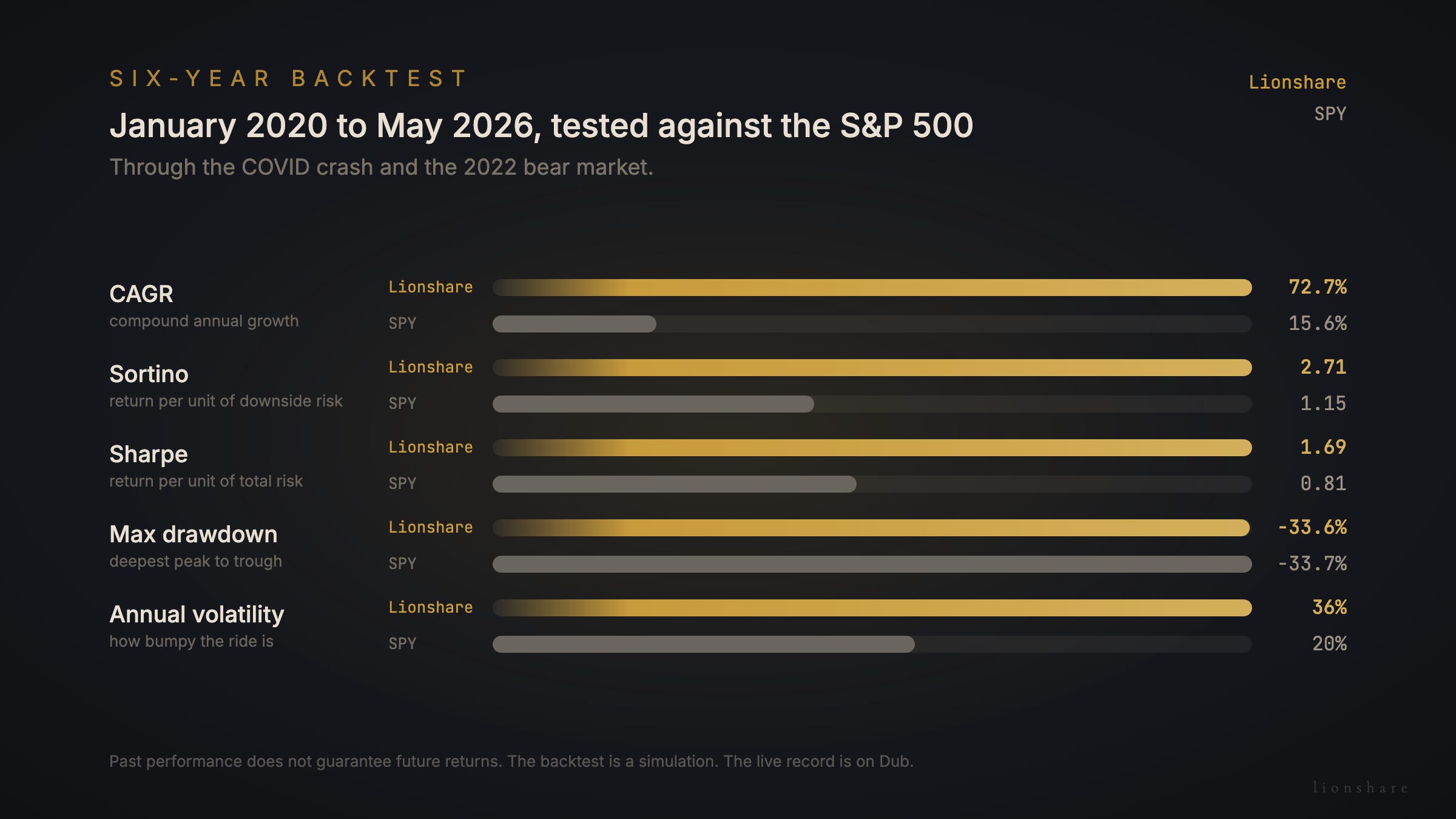
The max drawdown is real. The strategy draws down. It drew down roughly the same amount as the S&P during the worst stretch, but recovered faster and compounded harder over the full period. That is the tradeoff, the same depth of pain in the worst moments, far more growth across the whole cycle.
Past performance does not guarantee future returns. The backtest is a simulation, not a promise. The live record on Dub is where the real proof lives.
The Backtest: Link
The risks
This draws down. The worst stretch in six years of testing took about a third off the portfolio before it recovered, and a future drawdown could be deeper. There will be losing weeks and losing months, and you will see them in the open on Dub as they happen. The portfolio is concentrated by design.
Lionshare is a publication, not financial advice. I share what the system is doing with my own money. What you do with yours is up to you. I hold positions in the securities mentioned and may trade before or after publication. Past performance does not guarantee future returns. Investing involves risk, including loss of principal. If you need personalized guidance, consult a licensed financial adviser.
What a Monday looks like
The portfolio lands around 8:30 AM ET. Inside is the full list for the week. Around 10 stocks, each with a position weight and a stop level, along with the reasoning behind that week’s picks.
Each position is one line. The ticker, its target weight, and its stop-loss level. A name held at a 7.0% weight with a stop loss $ level, for example.
From there the trades go into any broker, with the stops set as standing orders at the same time. The whole thing takes about thirty minutes at the open. Then the rest of the week is free, nothing to watch and no news to follow.
What about Dub?
The same portfolio is available to copy automatically on Dub. Same positions, fully passive, and it works.
Dub’s primary purpose for Lionshare is transparency. It is the place where the track record lives in public, immutable and uneditable. The copy feature is a secondary benefit. The tradeoff for using it as an execution platform is precision and fees. Dub does not support stop-loss orders, limit orders, or advanced order types. Its updates happen on its own schedule, not at the market open, and its fee layer sits on top. The strategy still runs, but with less control and slower execution.
The Monday publication includes stop levels and exact position weights. What readers do with that is up to them. Some use Alpaca, some use Fidelity or Interactive Brokers, some use whatever brokerage they already have. The publication gives you the full picture. How you act on it is your decision.
Why I share it
I am not a fund manager or a guru with a secret. I wanted the same thing you do, money growing faster than an index fund through a repeatable process, not options bets or gut calls. I looked for something I could trust. Nothing held up, so I built it myself, tested it for years, and ran my own money through it first.
So why share it instead of just running it for myself? Sharing does not blunt the edge. This is not a scalping trick or a speed game a crowd erodes. It buys good companies the market is rewarding, names with market caps tens of billions to over a trillion dollars, so a thousand readers buying the same weights on a Monday would not move the price. The record you check is the same one I am measured against, and the subscription keeps that pressure on. It also pays for the work of running and publishing this every week.
More questions
What happens in a bad week? You get the same email, written the same way. The recap reports the loss to the number and the down weeks sit on Dub next to the up ones. My own money is down in those weeks and that is what keeps me stress-testing the system instead of explaining a bad week away.
How much time does it take? About thirty minutes on Monday morning, then your week is your own.
How do I cancel? One click from your account settings, anytime. The option is easy to find.
More questions are answered on the FAQ page
Getting started
The simplest next step is the free tier. You get the recap every week and can see how the system shows up before deciding whether the Monday portfolio is worth it.
